We show you the deliverable before you buy. The four pages below come from a real study, anonymized, with our notes on what each one tells a board. Ask for the full sample and one of us sends it, with a note on what to look at first.
Four of the seventy-six pages in one of our studies, with the community's name removed. The numbers are the study's own. Beside each page is what we would tell your board about it.
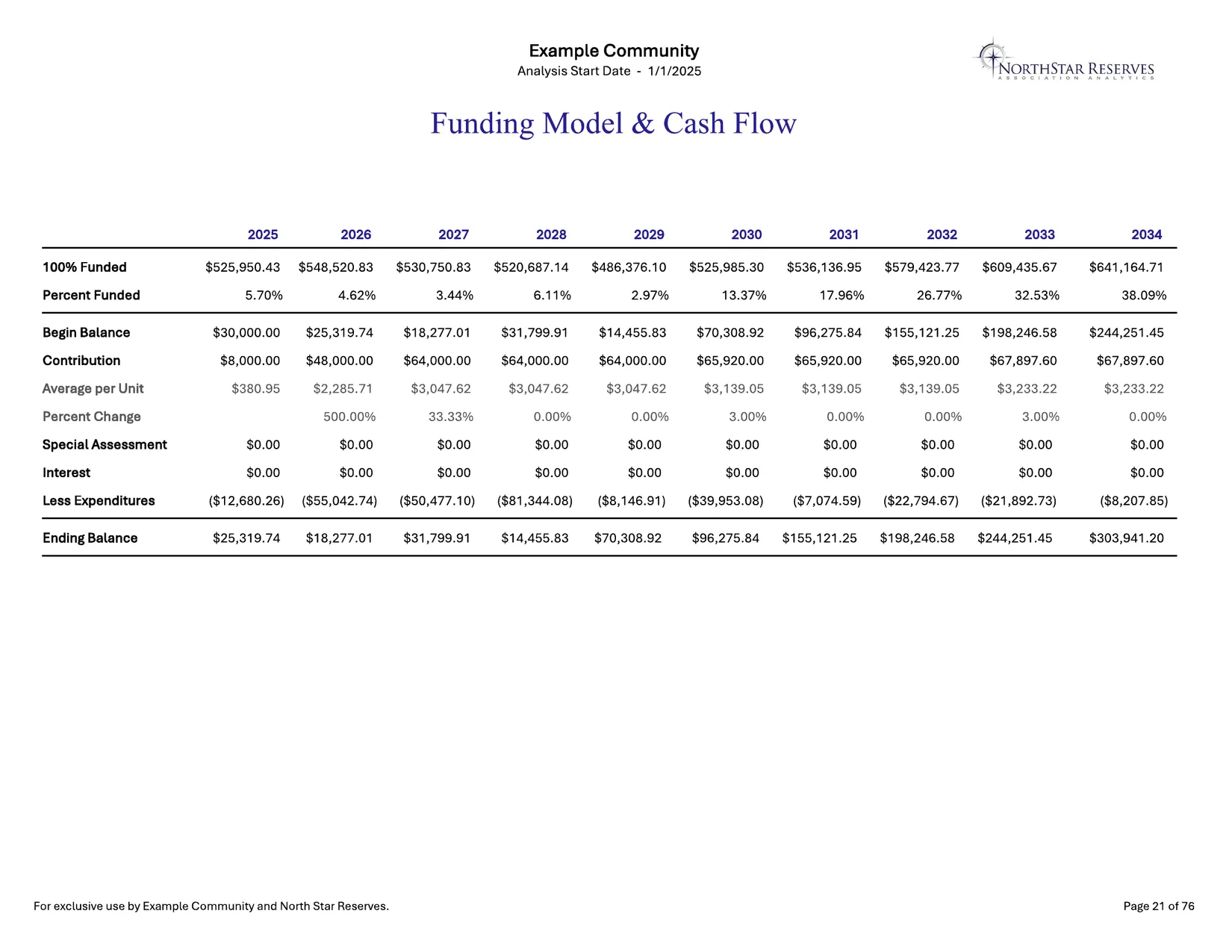
The Funding Model is the pinnacle report of the study. On one page, it tells the story of how financially prepared your community is to face upcoming cash outflows.
100% Funded
Means your association has saved exactly as much as its components have worn out so far. If a roof expected to last 30 years is now 15 years old, a 100% funded association has half the cost of a new roof set aside. It does not mean every future repair is already paid for; it means your savings are keeping pace with the wear.
Percent Funded
Your beginning reserve balance divided by the 100% Funded figure. A community below 30% is considered poorly funded. We see many communities start in the single digits, and we do our best to present a funding plan that gets you above 30% within the first decade. 30–50% is good, 50–70% is strong, and 70–100% is very strong.
Contribution
What dues put into the reserve fund today, and what it will take to reach your funding goals. When a community is underfunded, our experience is that it is best to correct the problem quickly rather than drag it out over several years — rip the band-aid off, so to speak.
Interest
Not enough communities take advantage of low-risk, interest-bearing accounts such as money market accounts or CDs. They can have a significant effect on the funding plan, especially as reserve balances grow to meet major future cash outflows.
On this page: In this example the association starts 2025 at 5.70% funded, with a $30,000 reserve balance against a fully funded figure of $525,950. The contribution steps from $8,000 to $48,000 in 2026 and $64,000 in 2027, and percent funded passes 30% in 2033, reaching 38.09% in 2034.
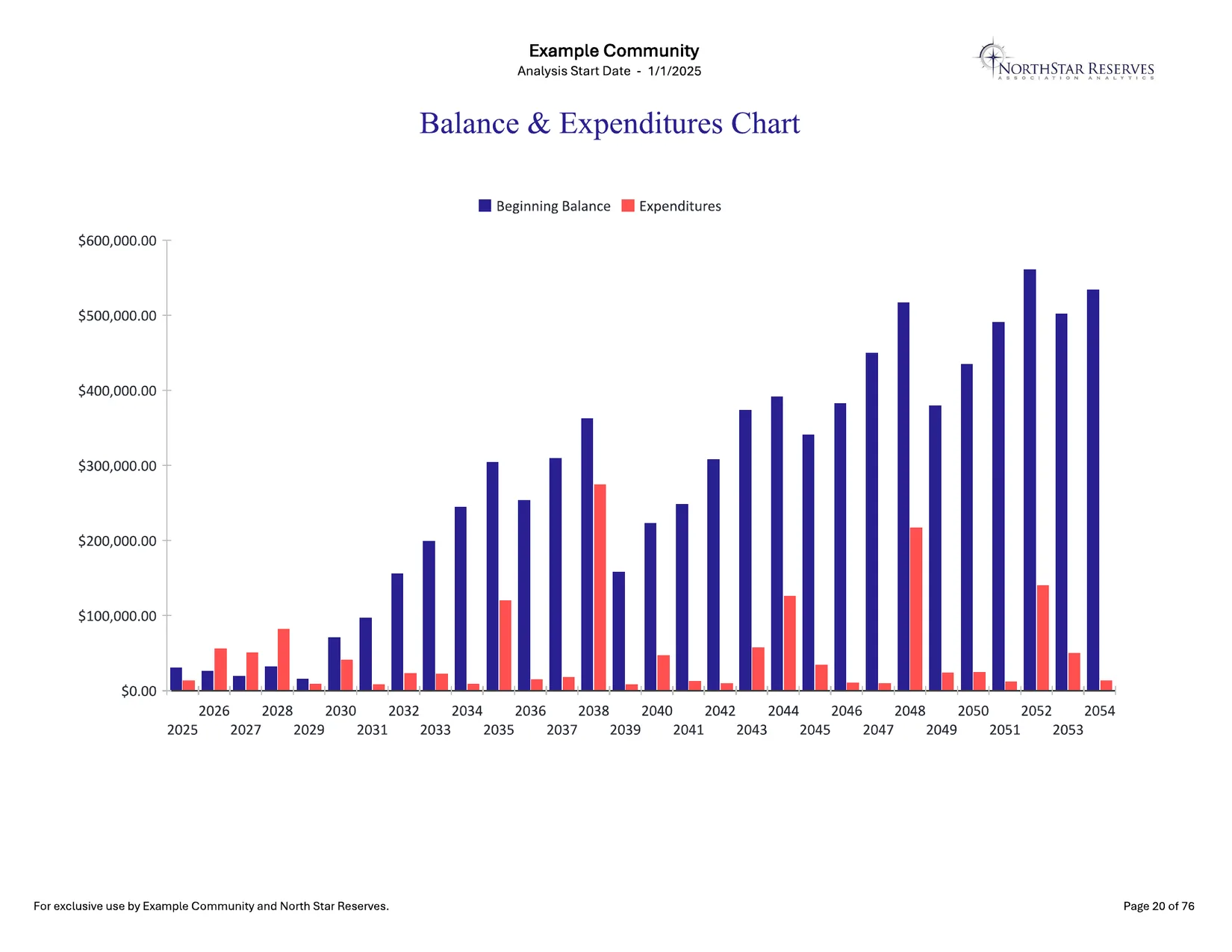
A visual representation of the funding plan. You can see at a glance the years in which the community will face major cash outflows.
Each homeowner should help pay for the assets that are wearing out, even when an asset will not need replacing for years. A properly funded reserve asks every member to contribute to the cost of the wear the community experiences that year. Someone who lives in a community for 29 years should contribute toward 29 years of wear on its assets; done correctly, a homeowner who leaves before an asset is replaced has already paid their fair share of its replacement cost.
On this page: Thirty years of beginning balance against expenditures, 2025 to 2054. The largest single outflow falls in 2038, at roughly $270,000, with further peaks in 2048 and 2052; the balance recovers after each and ends the period above $500,000.
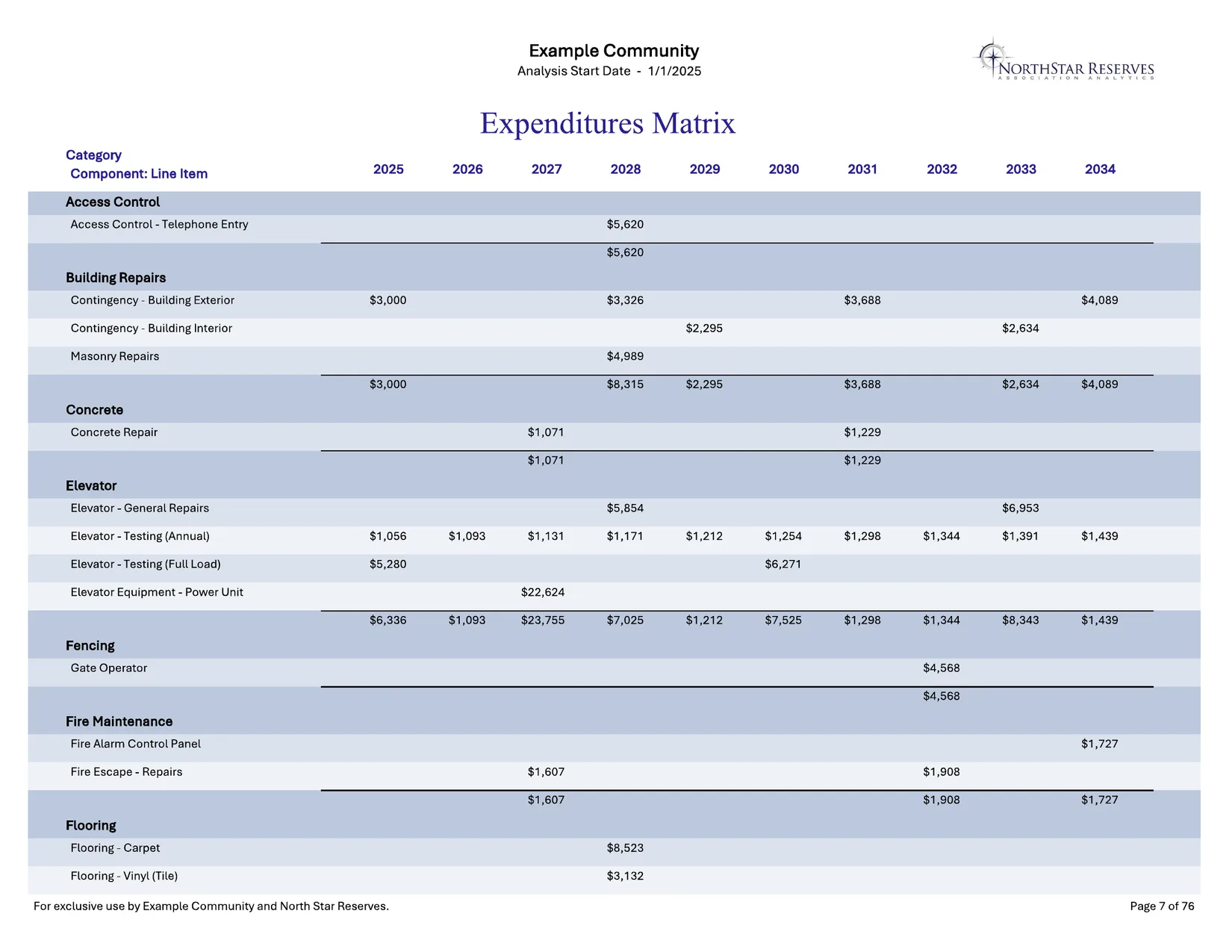
The meat and potatoes of the reserve study, part one.
Every asset — every component — we identify, with its expected year of replacement and its cost.
On this page: Components grouped by category — access control, building repairs, concrete, elevator, fencing, fire maintenance and flooring on this page — with each cost placed in the year it falls due, and a subtotal per category.
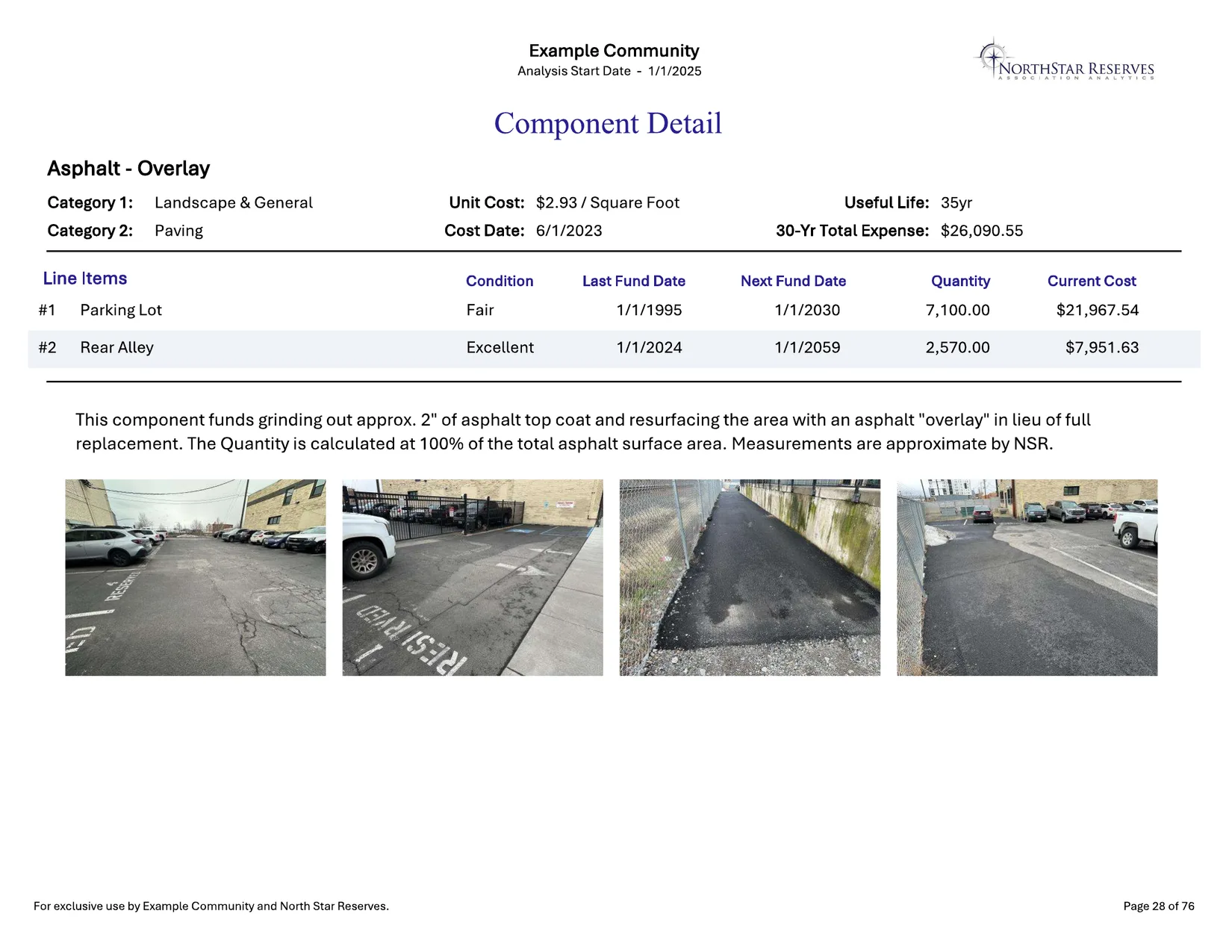
Every component has a detail page with photos we took on our site inspection and information about the replacement, repair or rehab, including cost.
Our inspectors look for signs of water damage and safety risks. Any concern we identify is noted here.
On this page: An asphalt overlay at $2.93 per square foot with a 35-year useful life, in two line items: the parking lot, in fair condition and next funded in 2030 at $21,967.54, and the rear alley, in excellent condition and next funded in 2059 at $7,951.63.
§ 02Full sample
Sent by one of us
Get the full sample report.
Want to see the whole thing? Tell us where to send it and one of us emails the full sample — usually within two business days, with a note on what matters most for a community your size. It is not an automated download, because the reply is the useful part.
§ 03Why it reads
What makes it readable.
Color-coded common-area mapping
You can see what you own, not hunt for it in a spreadsheet.
Plain-English summaries
The board can take the finding to the membership without translating it first.
Scenario-based funding views
Options, not a single number. The board sees what each path costs.